.png?imageMogr2/format/webp)
The right sheet metal fabrication process depends on volume, geometry and revision risk, not preference. Compare laser, stamping, turret punching and bending.
The question we hear most often is which process is best. There is no best. A sheet metal fabrication process is chosen by three facts — how many parts you need, how complex the outline is, and how likely the drawing is to change — and the same part can correctly take three different routes at three different volumes. What follows is how that call is actually made on the shop floor, and where buyers most often pay for the expensive route without realising it.
These Are Not Three Alternatives to One Decision
Laser cutting, stamping and bending are usually listed side by side, as if a buyer picks one. They do not compete on the same axis. Laser cutting and stamping both answer one question: how is the flat blank made? Bending answers a different one: how does the flat blank become a three-dimensional part? A laser-cut part still goes to a press brake. A stamped part still goes to a press brake. Framing the choice as three rivals hides the two decisions that actually drive cost — the blanking route and the number of forming setups.
Once the question is split that way, the conversation changes. The useful version is not "laser or stamping" but "at this quantity and this geometry, which blanking route is cheaper, and how many bends will the part need?" Those two answers can be quoted separately, and on most parts one of them is obvious while the other is where the money is.
What Laser Cutting Is Actually Good At
Laser cutting has no tooling. That single fact decides most of its territory. A prototype, a small batch, a part that will be revised next month — none of these should carry a die. The laser reads a program, so a change costs engineering time, not tooling money. It also handles outlines that a die cannot: long curves, tight internal cutouts, holes at odd angles, and thick material that would need an expensive die to blank. Nesting software also lets several parts share one sheet, which matters when the material is expensive.
What laser cutting does not do well is volume. The cut is serial — one contour at a time — so the per-part time barely falls as quantity rises. On a simple bracket at a few thousand pieces a year, that is fine. At a hundred thousand, the same bracket is a slow, expensive way to make a blank that a die could produce in a fraction of a second. The edge also carries a heat-affected zone, which is irrelevant on most parts and matters on a few.
Where Stamping Earns Its Tooling
Stamping is the opposite trade. The die costs money before the first good part exists, and that money is spent once. After that, the press produces blanks and formed features at a speed laser cannot match, with a repeatability that comes from the tool rather than the operator. For a part that is stable, simple enough to tool, and needed in real volume, the unit cost can fall far below any cutting route. The catch is that every drawing change after the die is cut means tooling money and tooling time, and the die does not care that the change looked small.
So the break-even between laser and stamping is not a fixed quantity. It moves with part size, material thickness, how many features the die must form, and how confident you are that the design is frozen. A large, simple part may never justify a die. A small, feature-dense part may justify one earlier than expected. The only honest way to know is to quote both routes at your actual annual quantity and compare total cost, not unit price.
Turret Punching: The Middle Route Buyers Forget
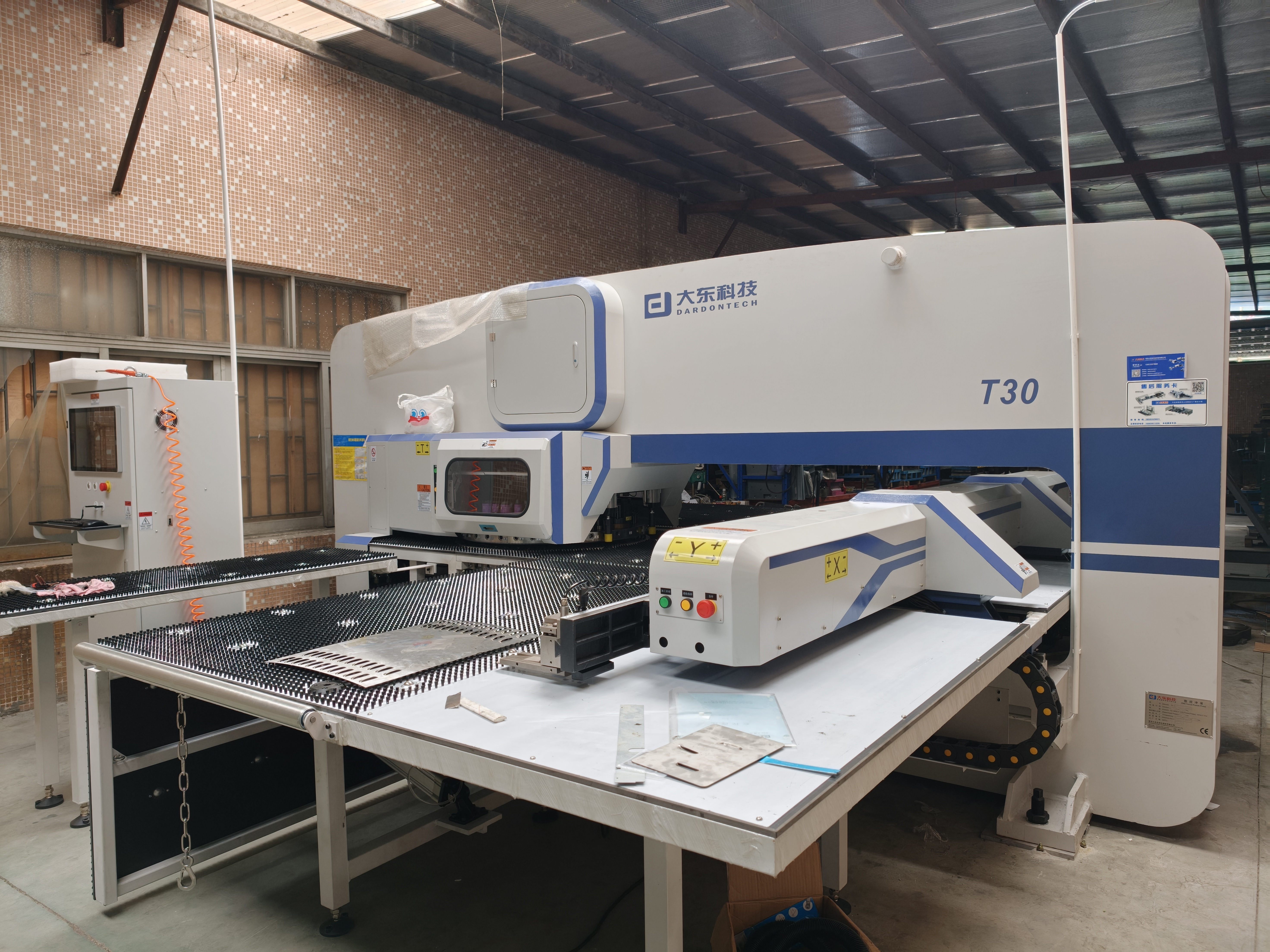
Between the two sits CNC turret punching, which is often left out of the comparison. A turret carries standard punches and dies, so there is no custom tooling to pay for. It punches standard shapes — rounds, squares, obrounds, louvers — fast and repeatedly, and it can combine many holes in one program. For a panel with a regular pattern of identical holes, it is frequently cheaper than laser at the same quantity, because it does not trace each contour; it hits.
Its limits are geometric. A turret works with the tools it has, so unusual outlines and large cutouts are either impossible or need a different route. That is why turret punching and laser cutting are often used together on the same part: the turret handles the repeated standard holes, the laser handles the outline and the features the turret cannot reach.
Bending Is Always Downstream — the Question Is How Many Setups
Every part with a third dimension needs bending, no matter how its blank was made. So bending is not a route to choose; it is a cost that every route inherits. What varies is the number of setups. One bend is one setup. Five bends in five directions can be five setups, each with its own handling, its own check and its own chance to drift. The number of bends, their sequence, whether they can be done in one handling, and whether the tooling for each radius is already on the shelf decide more of the part's cost than most drawings acknowledge.
This is also where design and process meet. A part designed with three bends where two would do has paid for a setup that buys nothing. A part that needs a special punch for one tight radius has paid for tooling that a slightly larger radius would have avoided. None of that is visible in a unit-price comparison, and all of it shows up in the quote.
The Four Numbers That Decide the Route
When we quote a part, four numbers settle the route before any machine is scheduled. The first is annual quantity, and whether it is stable or a one-off. The second is outline complexity: straight edges and standard holes behave very differently from long curves and irregular cutouts. The third is revision risk — how frozen the drawing really is, not how frozen it is described. The fourth is total cost: tooling amortised over the quantity, plus unit cost, plus lead time, plus the cost of a change if one comes.
Change any one of those and the answer can flip. A design that is stable, simple and high-volume points to a die. The same design at a tenth of the volume points to laser or turret. A complex outline that will never be revised can still justify a die if the volume is there, while a simple outline that is still moving should not be tooled at all. Buyers who compare only unit price are comparing the fourth number while ignoring the first three that produced it.
How the Routes Combine on One Part
Most real parts use more than one route, and that is not a compromise — it is the normal way to hit a cost target. A laser-cut blank goes to a press brake. A stamped blank goes to a press brake. A turret-punched panel may go to a laser for its outline and then to a brake. The shop's job is to choose the combination that minimises total cost at your quantity, which is a different exercise from selling whichever machine is idle. That is why we quote the route rather than a machine, and it is the same logic behind our sheet metal fabrication solutions for different production stages.
A quote that names a single process without explaining the combination is worth a second question. Ask which route made the blank, which route formed it, and how many setups the forming needed. The answer tells you whether the price reflects your part or the supplier's convenience.
Conclusion
There is no best sheet metal fabrication process, only a best route for a given quantity, geometry and revision risk. Laser cutting buys flexibility and pays for it in speed. Stamping buys speed and pays for it in tooling. Turret punching sits between them and is forgotten too often. Bending is not part of the choice at all — it is a cost every route carries, decided by how many setups the part needs. Get those four numbers right, and the route usually chooses itself. If you have a drawing and an annual quantity, we will quote the route that fits both. You can see the range of work this covers on our custom sheet metal stamped parts page, then send the file and the volume when you are ready.
Frequently Asked Questions
Is laser cutting always more expensive than stamping at high volume?
No. It depends on part size, material thickness, die complexity and how stable the design is. For very large parts, or parts whose die would be expensive to build, laser can stay competitive well past the volume where a simple small part would already be tooled. The break-even is specific to the part, which is why both routes should be quoted at your actual quantity.
Can a part designed for laser cutting be switched to stamping later?
Usually yes, because the finished geometry is the same, but the switch is not free. Stamping may require bend reliefs, different hole-to-edge distances for the die, and acceptance of slightly different edge quality. A part designed with the eventual route in mind avoids most of that rework, so it is worth telling your supplier which process you expect to scale into.
Do I need a custom die for turret punching?
No. Turret punching uses standard punches and dies held in a turret, so there is no custom tooling cost. The trade-off is geometric: the turret can only produce the standard shapes it is tooled for, which is why it suits panels with repeated identical holes and gives way to laser for unusual outlines.
How do I know whether my volume justifies a die?
There is no universal number. Compare the amortised die cost plus unit cost against the cutting route at your real annual quantity, and add the cost of any likely revision. If the design is still moving, the die's true cost includes every change it forces. If the design is frozen and the volume is stable, the break-even often arrives sooner than buyers expect.
Send us the drawing and the annual quantity. We will quote the route that fits both and tell you where the break-even sits — laser, stamping, turret punching, or a combination of them.
