
Features
Why Choose Juduo?
Every Process Under One Roof
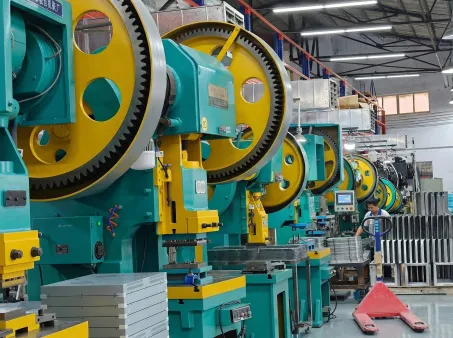
From laser cutting and CNC turret punching to stamping, bending, robotic welding, riveting, tapping and polishing, every operation runs inside our own 5,000 m² facility on more than 50 machines. Nothing leaves the building between steps, so one part number stays under one responsibility from raw sheet to finished assembly — no handovers, no gaps to argue about.
Not Every Part Needs a Die
Laser cutting and turret punching work with standard tooling, so prototypes, small batches and late design revisions carry no tooling cost at all. We propose a die only when the quantity and the geometry make it the cheaper route — and we tell you which side of that line your part sits on before you commit.
Checked at Five Points, Not at the End
Incoming material, first piece, in-process, assembly fit and pre-dispatch are each checked separately under an ISO 9001:2015 system, with stamping pass rates running at 99.8%. The reason for checking early is simple: a problem found at first piece costs one part, while the same problem found at dispatch costs the whole batch.
A Drawing, a Sample or a Photograph Is Enough to Start
Send PDF, STEP, IGS, DXF or PNG files, or send the part itself. Where no drawing exists, we design and manufacture to your requirement, then move from approved sample to small batch and repeat production. Every enquiry is answered within 24 hours.
We Have The Best Solutions for Your Business
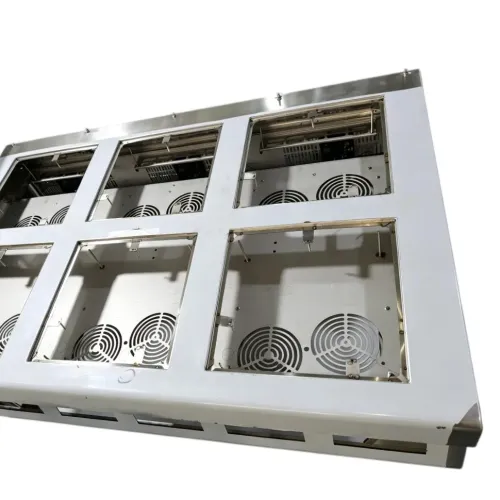
Founded in 2016, Zhongshan Juduo Hardware Products Co., Ltd. specializes in build-to-print metal stamping and sheet metal fabrication. We manufacture equipment housings, metal cabinets, structural assemblies, and stamped components according to customers’ drawings, samples, and technical requirements.
Led by a founder with more than 20 years of industry experience, our team supports tooling development, prototyping, small-batch production, and repeat orders. We work with customers to review materials, dimensions, tooling, and manufacturing requirements before production, helping balance manufacturability, quality, and cost. Surface finishing can also be coordinated through our qualified production partners.
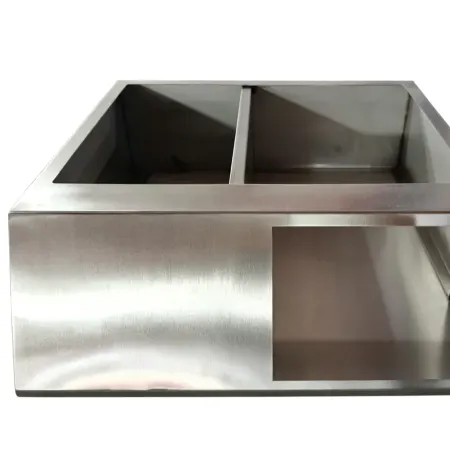
Stainless Steel Equipment Housings: Judged by How They Age
Two stainless housings leave different workshops on the same day, both bright, both to the same grade, both passing the same inspection. Two years later one still looks like equipment and the other has a brown line along a weld, a dull patch on a door and a shadow in every fold. Nothing failed. One of them was built with a longer horizon than the other, and the difference was set in five decisions made before either was cut.
A Housing Is Judged by How It Ages, Not by How It Arrives
An incoming inspection measures a housing on the day it arrives, when every stainless part looks the same. The judgement that matters is made by the end user over years, and it is not a judgement about corrosion resistance in the abstract. It is a judgement about appearance: whether the surface still reads as clean, whether the welds have stayed invisible, whether the folds have collected anything.
Stainless is chosen precisely because it does not rust away like carbon steel. That property creates a false sense of security, because the material can remain structurally sound while looking unacceptable, and appearance is what a customer sees. The failures that matter commercially are cosmetic and local: a heat tint that turns into a stain, a crevice that bleeds rust onto a visible face, a grain direction that shows every wipe.
All of these are workshop decisions. Grade selection, weld preparation, grain planning, joint design and drainage are fixed before the housing exists, and none of them can be corrected afterwards without refinishing the whole part.
The Grade Question: What 304 and 316 Actually Change
The austenitic grades used for equipment housings differ mainly in how they handle chlorides. The 316 family carries molybdenum, which improves resistance to pitting in the presence of salt and certain cleaning chemicals. The 304 family does not, and costs less.
The mistake is to read that as a ranking. In a dry indoor environment with occasional wiping, 304 will outlast the equipment it protects. In a coastal installation, a food plant that uses chloride-based sanitisers, or an outdoor housing that sees salt spray, 316 buys real time. The choice is a function of exposure, not of budget, and the exposure should be written on the enquiry rather than inferred from a previous project.
There is a second point that matters more than the grade and is often skipped: a higher grade does not compensate for a weld that was never cleaned. A 316 housing with heat tint left on the welds will show corrosion at those welds, and the customer will conclude that the material was wrong. The grade sets the ceiling; the process decides whether it is reached.
Weld Heat Tint and Why It Returns as Rust
Welding heats stainless steel enough to change it. Chromium near the weld combines with carbon and with oxygen, and the region that should be protecting the metal is temporarily depleted. The visible sign is a coloured oxide — straw, brown, blue, depending on how hot it got — and the invisible sign is that the passive layer is gone.
If that tint is left in place, it becomes the starting point for corrosion. Moisture sits on an oxide that is not protective, chlorides concentrate there, and the first rust appears exactly along the weld line, which is the most visible place on the part. This is why housings that "rusted in a year" are almost always housings with uncleaned welds.
The remedy is a sequence rather than a single action: remove the tint mechanically without smearing it, clean the area of iron contamination, and restore the passive layer chemically. The order matters, and so does the tooling — a brush or disc that has touched carbon steel will embed iron in the stainless and produce a fresh corrosion site that looks like a material fault. Dedicated stainless tools are not a formality; they are the difference between a repaired weld and a seed of future rust.
Grain Direction, Polishing and the Surfaces That Show Every Mark
Surface finish on a housing is a directional property. A brushed surface is a field of fine parallel scratches, and everything that touches it either follows that direction or interrupts it. A mark across the grain is visible from several metres; the same mark along it disappears.
This is decided in nesting. If the grain of each blank runs consistently across a visible face and through a fold, the assembled housing reads as one surface. If two panels meet with perpendicular grain, the joint shows even when the gap is perfect. On a part with a fold, the material on the outside of the bend is stretched, so its grain looks different from the flat face beside it — which is why the blank orientation should have been chosen with the fold in mind, not after it.
Polishing raises the stakes. A finer finish reflects more, and reflection reveals more: every scratch, every handling mark, every uneven blend. A mirror finish on an equipment housing is a commitment to protective film, careful packing and a customer who understands that the surface is decorative. A uniform brushed finish is more forgiving in service, which is why it dominates industrial equipment.
Crevices, Chlorides and the First Place to Fail
Stainless steel needs oxygen to maintain its passive layer, and a crevice is a place where oxygen cannot reach. That single fact explains most of the corrosion seen on equipment housings.
The classic crevices are familiar: under a lap joint, beneath a washer, inside a folded hem, at the root of a partial weld, behind a gasket that is not sealed. In each case a small volume of liquid sits, its oxygen is consumed, and the chemistry inside changes in a way that attacks the metal. The attack is invisible from outside until it bleeds.
Three design habits remove most of the risk. Close or weld the joint rather than leaving it open. Avoid absorbent or open-cell materials in contact with stainless, since they hold liquid against the surface. And give the housing a lowest point with a drain, so that whatever gets in can leave. Where a crevice cannot be avoided, the practical mitigation is to make sure it is not wetted — which is a geometry decision, not a cleaning instruction.
Designing for a Ten-Year Service Life
A housing that is still acceptable after ten years usually shares five characteristics, and all five are visible on a drawing.
A grade matched to the exposure rather than chosen by habit. Welds specified with a condition — dressed, cleaned, restored — rather than simply "welded". Grain direction indicated on the visible faces. Joints that close, or that sit where they cannot be wetted. And a drainage path that exists by design rather than by accident.
None of these add much cost when they are in the drawing. All of them are expensive once the part exists, because correcting them means refinishing, re-welding or replacing. Housings fabricated and finished for long service are not made from a better material; they are made from a longer set of assumptions.
It is also worth stating what will be checked, since the surface is the part that ages. The surface preparation applied before assembly determines how the housing looks in year three, and it is a process step that can be verified rather than assumed.
Conclusion
Stainless steel equipment housings are bought on dimensions and evaluated on appearance, and the gap between those two is where the workshop decisions live. Grade, weld condition, grain direction, joint design and drainage are all settled before the first blank, and each one shows up years later in a way that cannot be polished away.
The useful question for a supplier is therefore not which grade they use, but what they do to it after welding. A housing that is cleaned, restored and planned will still look like equipment a decade later. One that was only built to drawing will be structurally perfect and visually finished.
Frequently Asked Questions
Does stainless steel need painting?
Usually not, and painting a stainless housing introduces a coating that can chip and trap moisture beneath it. Where a colour is required, the surface needs proper preparation for the coating to adhere, and any breach becomes a corrosion site that is harder to see than bare metal would have been.
How do you remove welding discolouration?
Mechanically first, with stainless-dedicated abrasives that remove the tint rather than smear it, then chemically to restore the passive layer. The two steps are not interchangeable: polishing away the colour without restoring the surface leaves a weld that looks clean and corrodes anyway, which is one of the more confusing failures to diagnose later.
Can a housing be made from a thinner gauge to save cost?
Sometimes, provided stiffness is replaced by section rather than by thickness — a formed flange or a rib can do the work of an extra gauge. What thinner material cannot do is absorb the same abuse during handling and service, and on a visible housing a thin panel that deflects will also show every deflection as a change in reflection.
What causes tea staining?
A brown surface discolouration that appears without structural attack, usually from chlorides sitting on the surface, from contamination embedded during fabrication, or from a passive layer that was never restored after welding. It is cosmetic in most cases, but it indicates that the surface is not being protected as intended, and the same conditions that produced it will eventually produce pitting.
Tell us where the housing will be installed
Send the Housing and Its Service ConditionsPDF, STEP, IGS, DXF or PNG | Grade, welds and finish reviewed | Feedback within 24 hours
User Reviews
What users say about Juduo
Frequently Asked Question
Do you have any question?
No. 316 resists chlorides better, which matters where the housing meets salt, bleach-based cleaning or coastal air. In a dry indoor application with occasional wiping, 304 performs for years and costs less. The useful rule is to choose the grade from the exposure, then spend the difference on weld cleaning and surface restoration, which protect both grades from the failure that actually happens first.
Because welding destroys the passive layer and leaves a surface that is chemically different from the surrounding metal. Heat tint, iron contamination from a carbon steel brush or grinding disc, and unremoved spatter all create sites where corrosion starts. Cleaning the weld, removing the tint and restoring the passive layer are the steps that prevent it — and they are steps, not a polish at the end.
Small marks can be blended, but a local repair rarely matches, because the grain is set by the last abrasive and a spot repair leaves a patch with a different direction. Where the damaged area is visible, the workable approach is to re-finish a larger area evenly rather than polish the mark, and to accept that a repair on a finished housing is always a compromise.
One that is uniform and cleanable rather than one that is highly polished. A directional brushed finish hides handling marks and is easy to maintain; a mirror finish shows every fingerprint and every scratch, and outdoors it also shows water spotting. The more important specification is the treatment after fabrication — welds cleaned, contamination removed, passive layer restored — since that is what determines how the surface behaves in rain.
Our updates and blog posts
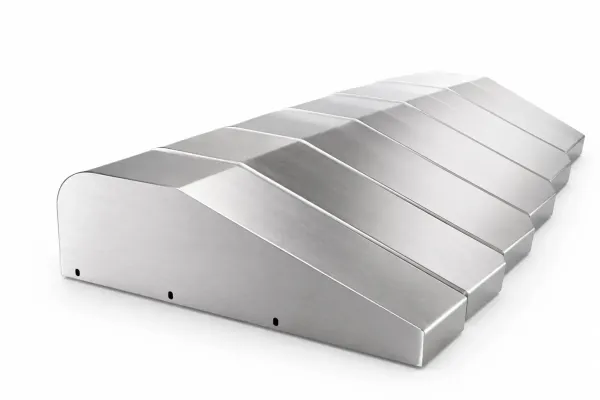
Aluminum Sheet Metal Parts: What Changes When the Drawing Says Aluminum
Aluminum sheet metal parts need a different bend radius, weld preparation, handling rule and finishing route. What to specify before you send the drawing.
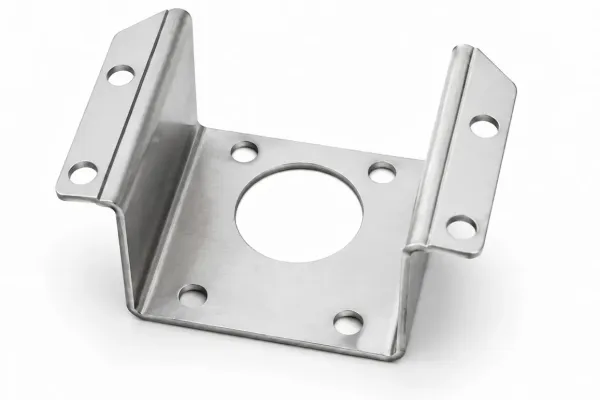
How Sheet Metal Lead Times Are Built, and Where the Days Go
Sheet metal fabrication lead time is a chain of material, queues, finishing and inspection decisions. Where the days go, and what buyers can control.
How to Choose Sheet Metal Material: Five Options and the Questions That Separate Them
How to choose sheet metal material depends on environment, process and finish, not strength. Compare stainless, carbon, galvanized, cold-rolled and aluminum.