
Features
Why Choose Juduo?
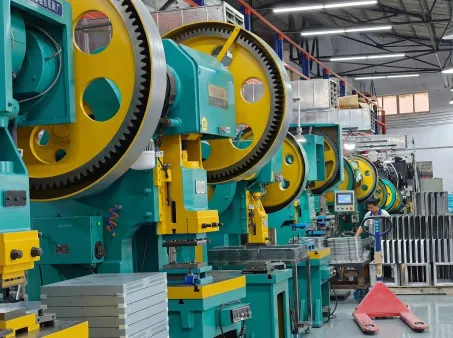
Every Process Under One Roof
From laser cutting and CNC turret punching to stamping, bending, robotic welding, riveting, tapping and polishing, every operation runs inside our own 5,000 m² facility on more than 50 machines. Nothing leaves the building between steps, so one part number stays under one responsibility from raw sheet to finished assembly — no handovers, no gaps to argue about.
Not Every Part Needs a Die
Laser cutting and turret punching work with standard tooling, so prototypes, small batches and late design revisions carry no tooling cost at all. We propose a die only when the quantity and the geometry make it the cheaper route — and we tell you which side of that line your part sits on before you commit.
Checked at Five Points, Not at the End
Incoming material, first piece, in-process, assembly fit and pre-dispatch are each checked separately under an ISO 9001:2015 system, with stamping pass rates running at 99.8%. The reason for checking early is simple: a problem found at first piece costs one part, while the same problem found at dispatch costs the whole batch.
A Drawing, a Sample or a Photograph Is Enough to Start
Send PDF, STEP, IGS, DXF or PNG files, or send the part itself. Where no drawing exists, we design and manufacture to your requirement, then move from approved sample to small batch and repeat production. Every enquiry is answered within 24 hours.
We Have The Best Solutions for Your Business
Founded in 2016, Zhongshan Juduo Hardware Products Co., Ltd. specializes in build-to-print metal stamping and sheet metal fabrication. We manufacture equipment housings, metal cabinets, structural assemblies, and stamped components according to customers’ drawings, samples, and technical requirements.
Led by a founder with more than 20 years of industry experience, our team supports tooling development, prototyping, small-batch production, and repeat orders. We work with customers to review materials, dimensions, tooling, and manufacturing requirements before production, helping balance manufacturability, quality, and cost. Surface finishing can also be coordinated through our qualified production partners.
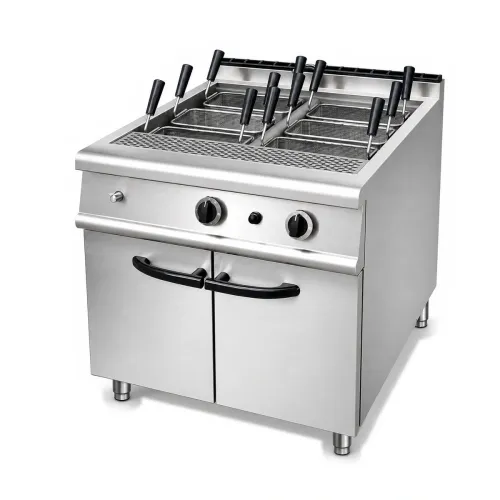
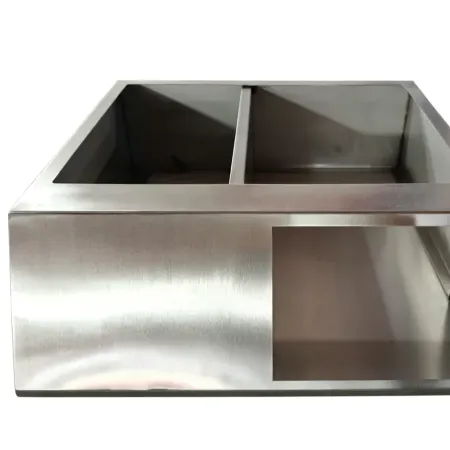
Commercial Kitchen Metal Fabrication: The Work Starts Where the Welding Ends
Ask a buyer what they are paying for in kitchen metalwork and most will describe cutting and bending. That is the visible part, and it is also the part that is hard to get wrong. The operations that decide whether an assembly arrives usable happen after the last weld: straightening, dressing, finishing, and fitting the thing together to see whether a door still closes. Those operations are rarely itemised, and they are where two suppliers quoting the same drawing end up in completely different places.
Where Kitchen Fabrication Differs From General Sheet Metal Work
General sheet metal work is usually judged part by part. A bracket is measured, a panel is checked for flatness, and if each piece meets its drawing the job is done. Kitchen equipment is judged as an assembly, and the assembly has requirements that no individual part drawing contains.
Three of them come up constantly. The equipment has to be cleanable, which pushes fabrication toward formed corners and closed joints. It has to be assembled and serviced by someone kneeling on a floor with limited access, which pushes toward removable panels and accessible fasteners. And it has to survive being moved, which pushes toward stiffness rather than lightness. None of these appear in a tolerance block, and all of them change how the parts are made.
The practical consequence is that kitchen fabrication is closer to assembly manufacturing than to job-shop cutting. A shop that only quotes per part will price the work it can see and underestimate the work it cannot.
The Sequence After Welding Is the Expensive Part
After a frame or housing comes off the welding table, it normally passes through four more stages before it can be called finished.
Straightening. Heat pulls a welded assembly out of shape, and someone has to bring the functional dimensions back. This is skilled manual work, it is rarely on a routing sheet, and it is the first thing a cheap quotation leaves out. A frame that is not straightened does not fail inspection if inspection only measures the parts before welding.
Dressing. Weld beads are ground, blended and, where the surface is visible, finished to match the surrounding grain. The amount of dressing is decided by the drawing's weld condition, and the cost difference between a dressed and an undressed joint is substantial on a part with many metres of weld.
Surface treatment. Cleaning, removing heat tint and restoring the passive layer where stainless has been welded. Skipping this does not show at dispatch; it shows as a rust bloom along the weld line months later, and by then it is attributed to the material.
Trial fit. Doors, drawers, panels and internal components offered up to the assembly before it is packed. This is the only step that catches an accumulation of small errors, and it is the one most often skipped when a project is running late.
Distortion: Why a Welded Frame No Longer Fits Its Door
Welding does not shrink metal evenly. Each joint heats a local area, that area expands while the arc is running, and as it cools it contracts against the colder material around it. The result is a frame that pulls toward whichever side received more heat, or toward the last joint completed, and the movement is often a few millimetres over a metre — enough to make a door bind at one corner and stand open at the other.
The controls are ordinary but they have to be planned. Welding in a balanced sequence, alternating sides rather than running one side to completion. Keeping heat input low with shorter runs and allowing cooling between them. Fixturing the part so it is held in the right shape while it cools, but not so rigidly that the restraint builds stress which is released later. And where the assembly is large or the joint count high, leaving machining or adjustment allowance on the interfaces that must end up accurate.
The door opening is almost always the dimension that suffers, because it is surrounded by welds on several sides and it is the dimension a user notices immediately. Where an opening matters, it is worth telling the fabricator that it matters — the response is usually a different welding sequence and a check after welding rather than before.
Finish Direction, Grain and the Surfaces Nobody Photographs
On a finished kitchen assembly, the surfaces that get photographed are the front panels. The surfaces that get judged are the ones a hygiene inspector sees with a torch: the underside of a shelf, the inside of a housing, the back of a door.
Grain direction is set by the last abrasive that touched the surface, and it shows most strongly under raking light. A panel finished along its length looks consistent from the front and shows a patch the moment someone repairs a scratch across the grain. The routine that works is to finish large panels in one direction, along the longest visible edge, and to blend any repair by repeating the full sequence over a wider area rather than polishing the mark locally. Local repair always leaves a visible island, and it always happens on the face that faces the customer.
The same discipline applies to folded edges, where the material has been stretched on the outside of the bend. Grain that runs across a fold looks different on the two faces beside it, and on a visible corner that mismatch is read as a defect even when the dimensions are perfect. Orienting the blank so the grain follows the fold, or so it runs consistently across a corner, is a nesting decision made before cutting — which is why it belongs in the review, not in the finishing shop.
Assembly Tolerance: Stacking Ten Small Errors Into One Gap
Every part in a kitchen assembly carries its own tolerance, and the assembly adds them together. A frame that is slightly out of square, a panel cut slightly long, a hinge mounted slightly high and a door folded slightly wide can each be within their own limits and still produce a gap that nobody accepts.
Two approaches keep this manageable. The first is to decide which dimensions close the chain and give those the tightest control, while letting the rest sit inside a general tolerance — the same logic as nominating critical dimensions, applied to an assembly rather than a part. The second is to build adjustment into the design deliberately: slotted holes on brackets, oversized clearance on cover fixings, shim points under a frame. Adjustment costs a small amount per part and absorbs the accumulation that would otherwise become a rework job.
What does not work is tightening every tolerance on every part. It multiplies cost across the whole assembly to solve a problem that exists at four interfaces, and it still does not guarantee that the door closes, because the closing depends on the sequence of assembly as much as on the dimensions of the pieces.
Choosing a Fabricator by What Happens After the Weld
Because the expensive stages are invisible in a quotation, they are best probed with questions rather than with specifications. Who straightens a welded frame, and how do they know when it is straight? Is the weld dressed to a defined condition, or until it looks acceptable? Is the assembly trial-fitted, and is there a record of what was adjusted? What happens to a frame that comes off the table out of square?
The answers separate shops quickly. A shop that has a routine answer for each has done this work often enough to have a routine. A shop that answers "we weld it accurately" is describing an intention, not a process. Kitchen metalwork built as complete assemblies requires the first kind of answer at every one of those stages.
It also helps to know how the whole job is sequenced, since the post-weld stages are where schedules usually slip. How a project runs from enquiry to shipment is a fair question to ask before awarding the work, and the answer should include the stages after fabrication, not just the ones up to it.
Conclusion
Commercial kitchen metal fabrication is decided in the hours after the arc stops. Straightening, dressing, restoring the surface and fitting the assembly together are the operations that turn accurate parts into equipment that works, and they are the operations a quotation is most likely to understate. Buying on price per part therefore compares the easy half of the job and ignores the half that determines the outcome.
The practical advice is short. Say which dimensions must survive welding, say which faces will be seen, and ask what happens to a frame that comes off the table out of square. A supplier who answers those three questions with a process rather than a promise is the one whose first delivery will look like the sample.
Frequently Asked Questions
Do you weld before or after forming the edges?
Forming comes first in almost every case, because a welded joint fixes the geometry and a subsequent bend would move it. The exception is a part where a closure is added after shaping, such as a cap welded onto a formed section. The rule that matters is that the last operation to set a dimension should be the one that is easiest to check.
How much distortion should I allow for on a welded panel?
There is no single figure, because it depends on the joint layout, the thickness, the welding process and the restraint. What can be done is to identify the dimensions that must hold after welding and to plan sequence and fixturing around them, leaving allowance only where it can be removed later. A panel with welds on one face will always bow toward the welded side; the design either accepts that or provides a way to correct it.
Can a warped frame be straightened after welding?
Yes, within limits, and it is a normal production step rather than a repair. Straightening uses controlled force and sometimes local heat to bring functional dimensions back. What it cannot do is restore a frame that was welded with so much heat that the material has lost stiffness, and it should not be used to compensate for a joint that was designed without access for the tools.
What is checked in a trial fit?
Whether the parts go together and function: door alignment and clearance, panel gaps, drawer travel, hinge binding, internal component clearance and fastener access. These are the conditions a drawing cannot fully define, and they are the ones a customer notices first. A trial fit that finds an issue at the factory costs an adjustment; the same issue found on site costs a service visit.
Build the assembly, not just the parts
Send Your Kitchen DrawingsPDF, STEP, IGS, DXF or PNG | Weld sequence and finish reviewed | Feedback within 24 hours
User Reviews
What users say about Juduo
Frequently Asked Question
Do you have any question?
Because welding adds heat unevenly and the metal expands where the torch is and contracts as it cools, pulling the frame toward the last joint that was made. Cutting accuracy only decides the starting geometry. Distortion is controlled by sequence, by how much heat goes into each joint, by how the part is restrained while it cools, and sometimes by leaving an allowance that is machined or adjusted afterwards.
A fabrication shop cuts, forms and joins parts to a drawing. An assembly shop fits those parts together, checks that doors close, panels line up and internals clear, and takes responsibility for the finished unit rather than for each piece. Kitchen equipment needs the second, because most of the problems that reach a customer are interface problems between parts that were each made correctly.
By fixing the direction before the panel is handled, then keeping every operation consistent with it. Grain is set by the last abrasive used, so a panel finished in one direction and then touched up in another shows a visible patch under raking light. Large panels are finished with the grain running along the longest visible edge, and any repair is blended by repeating the same sequence over a wider area rather than spot-polishing the mark.
Yes, and it is common for replacement or extension work. The unit is measured, the critical interfaces are recorded, and a drawing is produced so later orders have a document to build against rather than a machine to copy. Where the existing equipment has been modified on site, the differences are listed before production, because a frame that was cut and re-welded during installation is no longer the shape its original drawing describes.
Our updates and blog posts
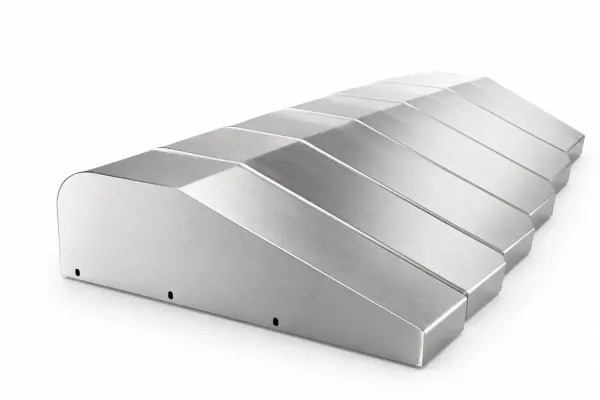
Aluminum Sheet Metal Parts: What Changes When the Drawing Says Aluminum
Aluminum sheet metal parts need a different bend radius, weld preparation, handling rule and finishing route. What to specify before you send the drawing.
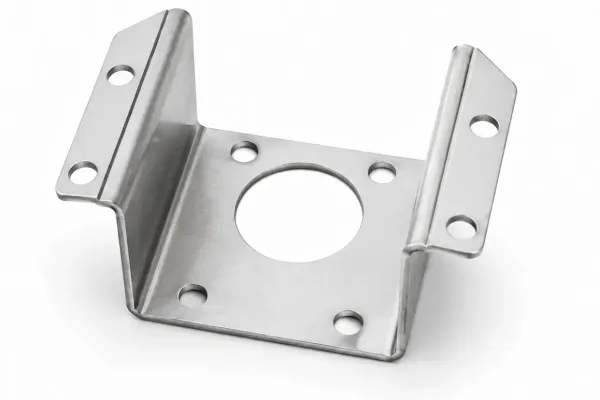
How Sheet Metal Lead Times Are Built, and Where the Days Go
Sheet metal fabrication lead time is a chain of material, queues, finishing and inspection decisions. Where the days go, and what buyers can control.
How to Choose Sheet Metal Material: Five Options and the Questions That Separate Them
How to choose sheet metal material depends on environment, process and finish, not strength. Compare stainless, carbon, galvanized, cold-rolled and aluminum.